
Package Contents
Application_Install.exe
I spent most of my life running from grief. Drugs, booze, relationships, jobs, anything with a dopamine hit. My grandmother’s murder was a capital T Trauma, and it was the easiest one I ever dealt with. The little t stuff is what wrecked me. The gaslighting, the shame, the carrot dangled in front of me for years. All of that loss piled up and I numbed every bit of it.
Then came sobriety, then cutting the cords, then going off the radar, and the bill came due. It hit me at a farmers market, to a Third Eye Blind song. Sharp as a thumbnail scratch. I cried. I said hello. By the end of the song it had passed and I was smiling. Grief isn’t the enemy. It’s proof I have a real heart and that what I lost was real.
That is the application. The rest is the source code.

Source_Code.txt
The open-source code below is free, for you to analyze, modify, and build your own application with.
> the night the phone rang: avoidance_origin.log
Grief for me is something I used to avoid, numb, and run away from as fast as I could. It was heavy. It meant crying. It felt uncomfortable. It was not desirable in any way. Staring at losses was so much harder than just looking away and pretending they didn’t exist.
I didn’t know what grief was until May 5, 1995. That was the night my grandmother was murdered at gunpoint. I was in my bedroom playing. I heard the phone ring. Moments later I heard a scream from my mother that would curdle your blood.
I froze. I didn’t know what to do. I hid in my room until my stepfather brought me out and told me what happened. I don’t remember much more than that. The living room. The TV on. Lamps lit. Nighttime out.
I didn’t know my grandmother well. But it was the first time I ever saw loss hit somebody else. I watched my mother struggle with it for a long time. I’ve watched several people in that family avoid it completely. They just don’t talk about it. My mother barely did after the funeral.
Grief and death stuff in the 90s, and the decades before, was taboo. Someone died, you mourned until the funeral, you went to the dinner afterwards, and then it was over. Back to work. Back to life.
> big T, little t: trauma_ledger.csv
It may seem like a horrendous traumatic event. It was probably the easiest trauma I have ever dealt with. It was a capital T Trauma, the kind the DSM defines and has well established.
The little t traumas are the ones that fucked me up the most. The headgames. The shame. The gaslighting. The manipulation. The betrayals. The lies told. The impossible standards I could never meet. Love dangled in front of me like a carrot. Being accused of things I am not or did not do. Being called a liar when I was telling the truth. Being called manic when I am stable. And oh, so much more. And all of it usually because the person doing it is avoiding accountability.
The one that stings the most is having my experience twisted into a fabrication, then used against me. In the last year, a rumor was created, spread, and then on top of that, used to make multiple crisis calls and false reports about me being manic and suicidal. That hurt me deeply. It left me unable to trust swaths of people.
The little t traumas are the ones that caused the most loss, and the grief I spent most of my life avoiding. I avoided it with drugs, alcohol, relationships, adventures, dopamine, jobs, habits, hobbies, and anything else I could grab. The full list is further down.
They took my freedom. My autonomy. My belief in myself. My love for myself. My emotional safety. My innocence. My childhood. My happiness. My wonder. My intuition. My physical safety. My sexual safety. My financial security. My respect. My dignity. And so many other things.
> the stack i never opened: unread_losses.db
It took sobriety for me to start seeing the losses and fully grieving them. And sobriety wasn’t enough. It took severing cords connected to many of those losses. Then it took severing the biggest one, and going completely off the radar last month, taking a massive amount of emotional and physical space from nearly everybody and everything.

Until I did that, I couldn’t even begin to process the stack of grief that had piled up since I was a child. I believe it may have started at a few weeks old. I spent my whole life dodging it with every pattern I could find.
The first week, I felt quiet and relieved, like I’d set something heavy down. I also felt numb. I was waiting for the wave to hit me hard, out of nowhere.
It hasn’t come. No tsunami. Just little ripples of grief, at intervals and intensities I can handle and process.
I feared something huge. Reality is that grief is the little things. It isn’t always a phone call with your mom screaming.
> the wave i didn't see coming: third_eye_flashback.wav
Today I was at the farmers market. My usual Saturday adventure. I had my headphones on, and a song came on that took me right back to the 90s. Third Eye Blind, “How’s It Going to Be.” I felt tears come into my eyes. There I was, surrounded by people, and a big sneaker wave of grief slammed into me out of nowhere.
Sharp as a thumbnail scratch. Impossible to ignore, like an actual deep scratch.
It took me straight back to high school. I never even listened to the lyrics then. I just felt the vibe of the songs. I was a loner. Alone, and lonely. My mom moved me away from my hometown and my dad, onto 53 acres in rural Idaho. Middle of nowhere. Off the grid. No electricity. No internet. I had to ride my bike 7.5 miles down a washboarded dirt road to a pay phone, call my dad on a calling card, and hope he was around to answer. Then ride 7.5 miles back.
So the song put me right back in that depressed state. Isolated. On a figurative island in the foothills of the Payette National Forest. Surrounded by the loss of the life I lived for my first 14 years. No dad across town. No friends. No anyone. Just me on a dirt road, an hour-long bus ride from a school where I didn’t fit in with my class of 12. More loss there too.
I let the tears come. I named it out loud. “Hello grief, my old friend. I feel you. Flow through me.” By the end of the song, the grief had done what it needed to. The next song came on and I caught myself smiling, soaking up gratitude for that moment of grief.
> proof i still have a heart: gratitude_check.sh
Gratitude for grief? Yes. Grief is a beautiful part of my life now. Beautiful? Absolutely. It tells me I have a real beating heart. That I had real love for something I lost. That the things I loved really mattered to me, and were real things.
It also tells me I am not a terrible person with a malicious, evil heart. I needed that proof. For most of my life I believed the opposite. The people who fucked with my head, the ones who delivered the little t traumas, destroyed my view of myself. My entire life. Right up until August 27th, when I finally realized the gaslighting I was still living in. I wrote about that in I_Am_Getting_Married_v1.zip. The tears running down my face say I am still love deep down inside, the same way I came into this world. I’m still capable of loving the way I’ve always wanted to.
I’m grateful for another reason. Grief helped me stop taking things for granted. My parents who died. The friendships, marriages, and partnerships that no longer exist. The pets who died. Experiences I can’t go back to. The health I had when I was younger. Everything. Everything in your world can end abruptly, with no warning. Expecting anything to be there tomorrow isn’t wise, and it blocks gratitude for what you have right now.
> how the body hears it first: amygdala_bypass.sh
Before I learned to name a feeling out loud, I did everything but. I drank and used. I left the room, the relationship, the town. I stayed busy with work, adventures, projects, hobbies, and habits. I picked fights and fixed everybody else’s problems. I made as many connections as I could, good for me or not. I ran my patterns and my codependence. I threw myself into the Wild Buffalo as often as possible. I did performative volunteering. And that’s only what I can remember. There was so much more.
There are 7 stages of grief according to one model I believe and align with. 1. Shock. 2. Denial. 3. Anger. 4. Bargaining. 5. Guilt. 6. Depression. 7. Acceptance and hope. Today I felt the denial, the depression, and then right away the acceptance and hope. Sometimes I feel all 7. Sometimes out of order. Sometimes all at once. Sometimes in a loop.
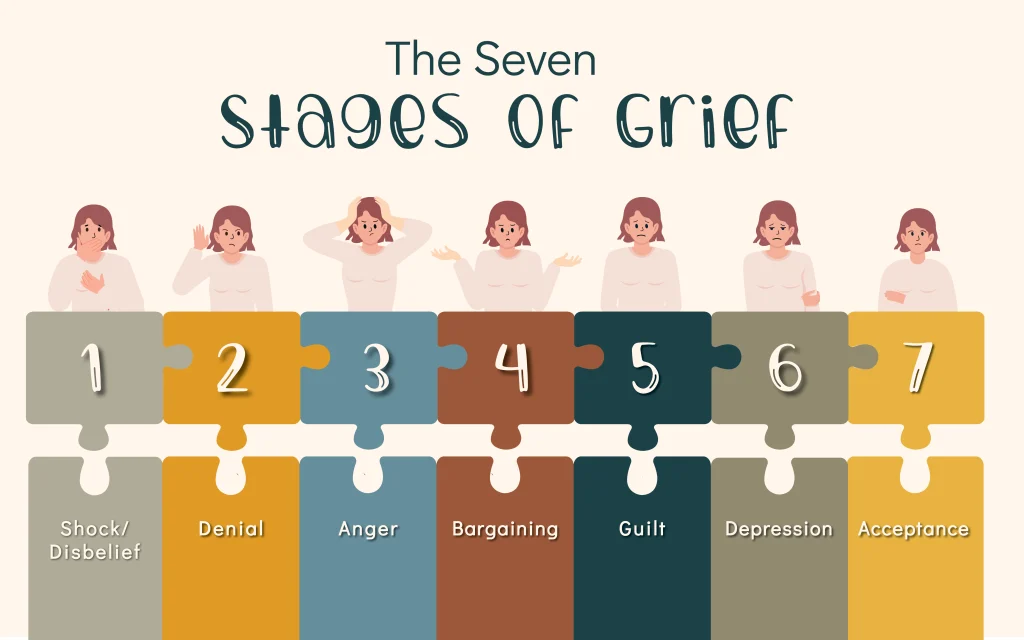
Grief never goes away, because the loss that created it is always there. That’s why we can’t avoid it. To avoid and deny our losses is to deny our entire existence. Every second you’re alive, every heartbeat, you lose that moment as it fades into the past. We’re in a state of perpetual loss and perpetual gain, all at the same time, as long as we’re alive.
One thing that helped me was reframing everything as information. Every feeling is just information. Not good, not bad. In the body it’s a sensation caused by chemicals in the nervous system. Even thoughts are chemical reactions. No bad thoughts. No bad feelings. No bad parts.
When we judge a feeling, call it bad, or get mad that we’re having it, it grips us. It takes away our power to be with it and lets the feeling have power over us. If we believe we shouldn’t feel it, shame floats right on in. And we know what that monster does.
Here’s what helps with feelings we want to avoid. Name them out loud. Literally say “I am feeling ___” with your mouth and vocal cords. When an uncomfortable feeling starts, the amygdala kicks in. It doesn’t care about reason, morals, or beliefs. It only cares about keeping you alive. It sounds the alarm, and your body goes into fight, flight, freeze, or fawn. Cortisol and adrenaline flood in. Your heartbeat and breathing change, your chest tightens, your pupils dilate. None of that feels good, so we do everything we can to never feel it. Avoidance is flight. Get distance, and the chemicals subside.
In brain imaging studies, putting a feeling into words quiets the amygdala and hands the feeling to the thinking part of the brain, which can actually do something with it. It isn’t a miracle fix. But since I started saying the words out loud, things have changed dramatically.
At the farmers market I said, “Hello grief, my old friend. I am feeling you right now.” In seconds, the intensity shifted and felt immensely lighter.

For me it works best out loud. Writing it down helps some. Saying it is where the magic happens. It’s no coincidence you feel better after a therapy session where you finally say the feelings you’ve been keeping inside. It’s why I believe so much in giving people a space to be witnessed and heard.
> the question with no answer: unreplied_query.log
How’s it gonna be when you don’t know me anymore?
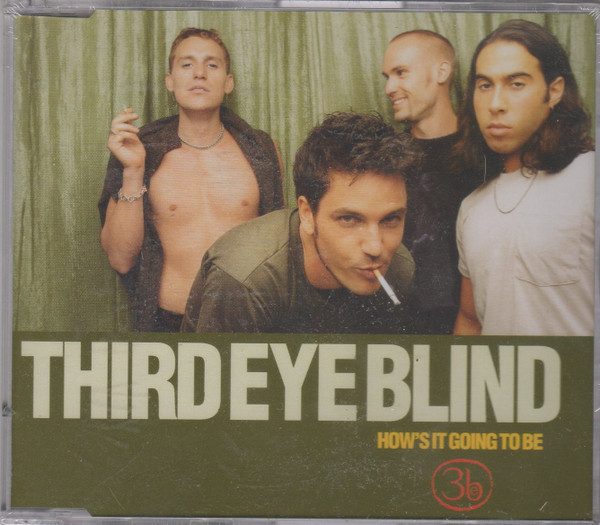
The severing of cords I’ve been doing since the big reset hit this line the hardest. A plethora of people are quickly not knowing me anymore. They’re becoming sure I’m not around to talk to. Where laughter once existed between us, unresolvable conflict has filled the space. There’s a silence now that neither of us can ignore.
That line hits because it says the loss out loud. It asks a question I’ll never get an answer to, because the cords are cut and the connections are severed. I’m never going back to any of it. The loss is permanent and final.
Words left unspoken will never get spoken. Some goodbyes will never get said. Repairs won’t be made. Reconciliations won’t be made. They’ll never get to explain themselves. The opportunities for all of it came, and went. I’m not holding the door open for later. That means I’m welding the door shut, and my entire soul struggles with that. I may never get answers. I have to move forward never knowing the whole story, and never hearing certain people’s voices again.
The permanence is the hardest thing I’ve had to come to terms with. It’s also the last stage: acceptance and hope. I wrote about acceptance in Good Grief, and it’s the path forward. We can’t make losses go away. We can only find acceptance in them, and hope for the life ahead.
> what i'd say if you read this: unsent_message.txt
If one of them reads this, here’s what I want them to hear.
I love you unconditionally, and this time with distance and no contact. I want peace and less suffering for you. I want you to live your best life and move forward without me in it.
I’m hurt. I know you’re hurt. I’ve decided the best thing is to let the hurt exist without trying to fix it, because some things can’t be fixed.
I’m moving forward in a way that doesn’t knowingly and willfully repeat my harms. When I do something that hurts someone, I own it immediately, and I’m accountable for it by never repeating it.
I’m improving and healing myself. I wish for you to find the ability to do the same. When both of us do that, humanity improves and heals. But I can’t do that work with you in my life anymore. While I cannot speak for you, I personally believe you can’t do that work with me in yours either. I wish there was another way.
I release and let go. I hope you can too.
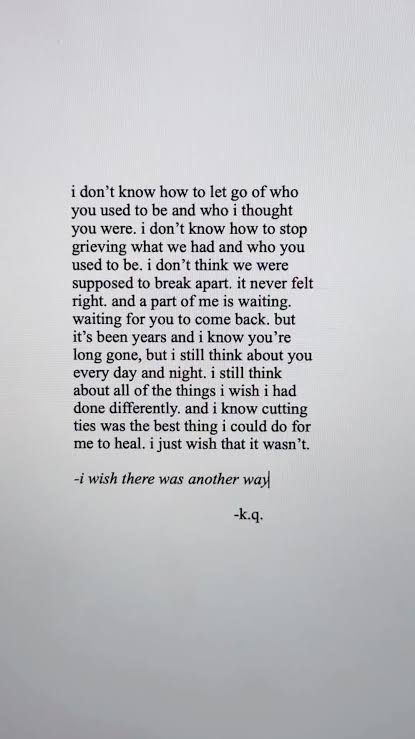
Maybe tomorrow.