
PS C:\> tar -xf The_Blame_Boomerang_aka_DARVO_v1.zip
Application_Install.exe
There’s a name for what happens when you tell someone the truth and they turn around and make you the villain for saying it. I call it the blame boomerang, psychology professionals call it DARVO. Deny, Attack, Reverse Victim and Offender. Three moves, and once you learn them you cannot unsee them happening to you, or to anyone else.
Here’s the part that took me the longest to believe. A factual letter with real numbers highlighting a legitimate relationship problem is not a manic episode. A boundary that exists in your own written words does not stop existing because someone says it doesn’t. If someone you trust ever uses your diagnosis as the reason your memory can’t be believed, that’s not a disagreement. That’s the tactic working exactly as designed, and it says everything about them and nothing about your grip on reality. I’ve written a little bit about this in other posts, but I have been sitting with my knowledge of DARVO for several months and want to elaborate further.
That is the application. The rest is the source code.
Source_Code.txt
The open-source code below is free, for you to analyze, modify, and build your own application with.
> before I said it out loud: self_doubt.log
For a long time I thought I was losing my mind. Not in the dramatic sense. In the quiet sense. The sense where you start rereading your own emails to make sure you actually wrote what you remember writing. Where you check a text thread three times because someone told you something happened that you know didn’t. Where you start every sentence in your head with “maybe I’m wrong about this” before you’ve even said it out loud.
I am not wrong about this. I know that now. But I didn’t always. And the reason I didn’t is a psychological pattern with a name, one that took me a long time to learn, and one I wish I had known years earlier than I did.
It’s called DARVO. I first mentioned it earlier this year when I wrote about the “manic bullshit” label being thrown at me. I have been researching DARVO for several months and analyzing several situations from my past that were extremely manipulative, involved deep gaslighting, and weaponized my diagnosis. I am going to elaborate in this post more on what I have come to understand about these situations and how DARVO was used specifically within them.
> the three moves you can't unsee: darvo_defined.py
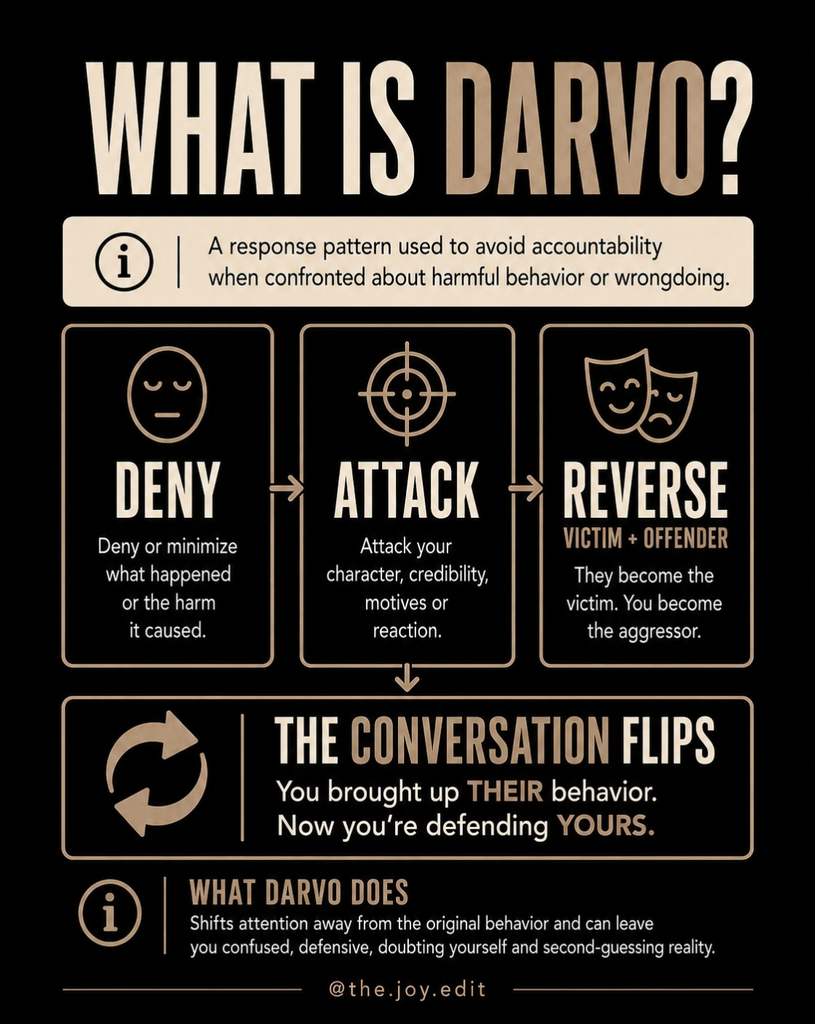
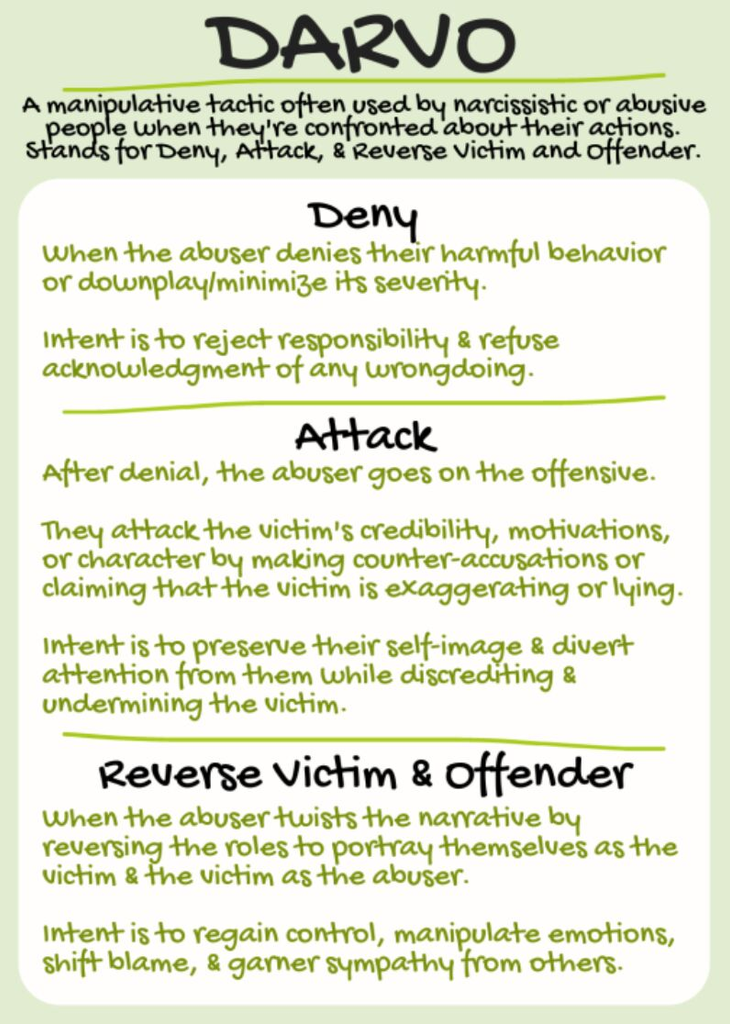
If you are just finding my blog and haven’t read the other posts about DARVO, DARVO stands for Deny, Attack, Reverse Victim and Offender. The psychologist Jennifer Freyd coined the term in 1997, and her definition is still the clearest one out there. As her research site puts it, DARVO describes what happens when the offender “assumes the victim role and turns the true victim, or the whistle blower, into an alleged offender.” It is, in plain language, what a person does instead of accountability.
It works in three moves, and once you see them you cannot unsee them.
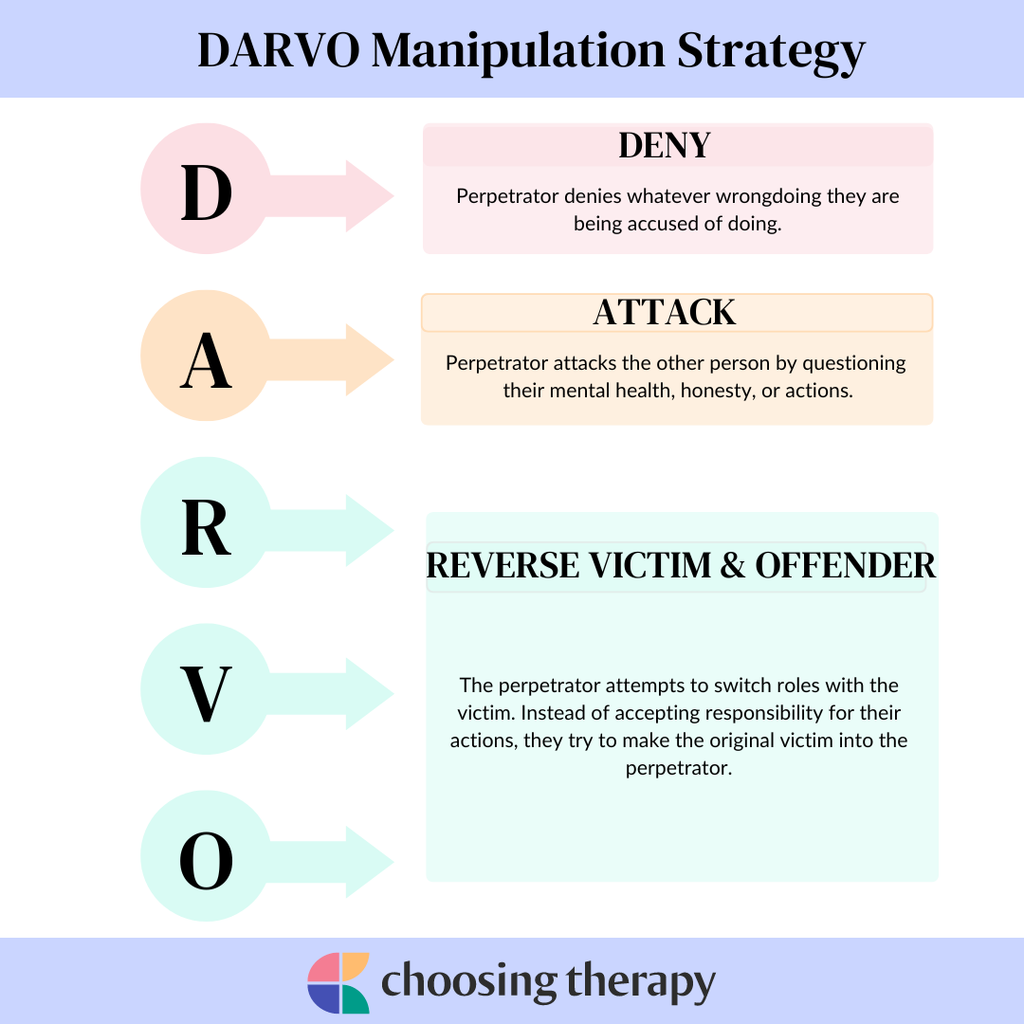
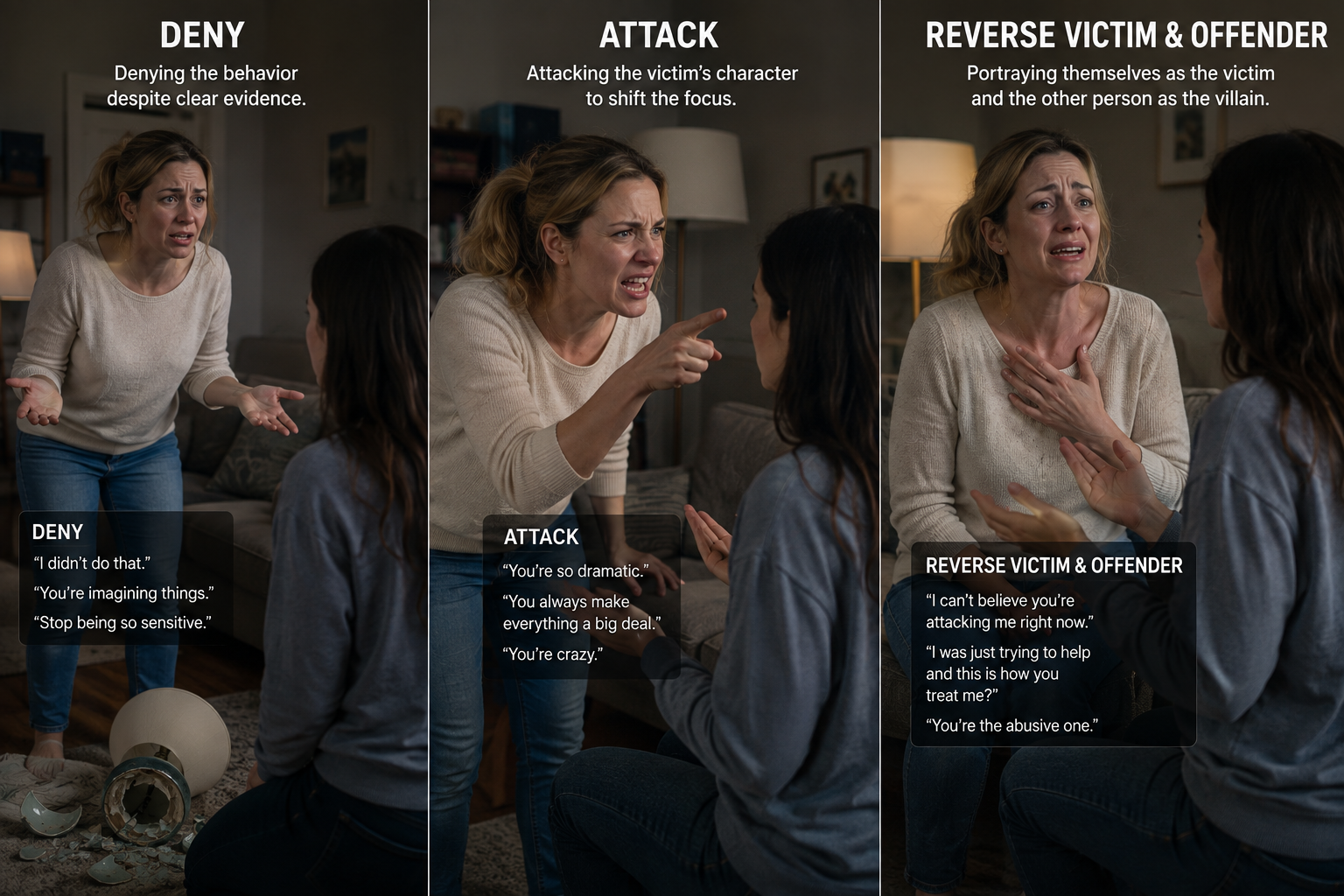
Deny. The thing you said happened did not happen, according to them. Not “I remember it differently.” Not “I disagree.” It didn’t happen. Full stop.
Attack. Once denial is on the table, the conversation stops being about what they did and starts being about what’s wrong with you for bringing it up. Your tone. Your stability. Your credibility. Your mental health.
Reverse victim and offender. This is the move that makes the whole thing work. The person who did the harming becomes the one who is hurt, scared, and in need of protection. The person who was harmed becomes the threat.
Researchers Sarah Harsey and Jennifer Freyd have studied what this does to the people watching from the outside, not just the person on the receiving end. Their findings are blunt: when someone witnesses a DARVO response, they tend to see the perpetrator as more credible and the actual victim as more responsible for what happened. The tactic does not just work on the person it is aimed at. It works on everyone standing nearby.
I lived through two versions of this in one of my past relationships (and other examples I am not going to share here from other past relationships). I want to tell you both, because they look different on the surface and they are the exact same move underneath.
> the letter THEY called manic: receipts_v1.txt
For years I carried more than my share. Rent covered on a credit card when they couldn’t make it. A plane ticket I paid for in full when they couldn’t afford their half. Household supplies I bought over and over without it ever going the other direction. Vacation time I kept waiting to use together that never got used. I wasn’t keeping score out of resentment. I was just waiting, the way you do when you love someone and you think the balance will even out eventually.
One morning I woke up and realized I was done waiting. I couldn’t avoid the conversation a minute longer. I wrote them a long letter. I laid out the numbers plainly. Thousands of dollars loaned and nothing repaid. Trips I’d funded alone multiple times. Supplies I kept buying that they kept consuming without ever replacing. Groceries, meals, drinks, utilities, even their half of the rent wasn’t always paid in full…you name it…same pattern. They were always broke, and my money was the cure, and I was making less income than them. I wasn’t cruel in that letter. I was specific. I was honest. I named a pattern that had been true for years and that I had never said out loud.
They called it manic bullshit.
Not “I disagree with your accounting.” Not “why now?” Not even “that’s not fair.” They reached for the one word that could do the most damage to me specifically, because they knew my bipolar diagnosis and how much of a struggle it is for me to manage (on a good day). A word that they knew other partners had also traumatically weaponized using DARVO with me in the past. They knew what that word could do to my confidence in my own memory and my self-esteem. And it worked, for a while. They even told me after I went silent that they were glad I cycled out of mania and that we didn’t need to discuss it any further or have a conversation. I had started wondering if a detailed, dated, factual letter about money I was actually owed was somehow a symptom instead of a fact. For a moment I believed it all. That I had been manic. That I had cycled out of it. That a follow up conversation wasn’t necessary.
It wasn’t mania though. It never was. It was them dodging a bullet of accountability. They knew that I was right and they were in the wrong. And the quickest way to change that dynamic is to make ME more in the wrong than them. That is the deny and attack moves working together: deny that the content has any merit, attack the person by reaching for the label most likely to make them doubt themselves. I spent weeks believing that I was overreacting. Until I shared it with several trusted and unbiased resources, and all of them said there was nothing wrong with what I said, and everything wrong with how my mental health was unjustly used against me.
Some of the waiting was my pattern of avoidance that existed because of my fear of abandonment and losing the love in the relationship. I own my avoidance pattern. I own the damage and disruption the pattern caused when I abrupty put my foot down and stopped avoiding the brewing storm. I have been accountable for this pattern and the damage from it, and have been living my amends by never repeating it since. My avoidance pattern and the way it impacted others doesn’t make the DARVO justified though. The DARVO doesn’t excuse or minimize my avoidant behaviors and impacts either. Both were destructive and harmful.
> a boundary that stopped existing: no_contact_deleted.log
When I confronted them about the letter a second time, with printouts of the debts and promises to repay me, and then ended the relationship, I was attacked. “I can’t believe you are doing this to me right now…this is more of your manic bullshit…you didn’t even have a conversation with me about any of this…fuck you asshole…I’m done with your bullshit …don’t ever contact me, my family, or my friends again.”
DARVO again. Denied the information that had been presented in the letter initially. Then denied the letter and debt repayment promises printed out and handed to them during the breakup. Literally denied paper in their hands. Attacked me with names and expletives. Made themselves the victim and made me the villain.
After I ended that relationship, I set a no-contact boundary in writing, in an email, immediately following the emotionally abusive separation behavior. Within hours they violated it. Then violated it again the next morning. Several weeks later they showed up to my home unannounced and left things near my front door, violating it again. Not the thousands of dollars of money they owed me. Not the jewelry or other gifts. Not the hundreds of dollars of expensive storage crates they stole and loaned electronics they never returned. Not anything tangible or worth any kind of money. A few zero-value items, specifically two love notes and a duplicate retail store rewards card that I could easily replace if needed. Things that could have been mailed to me, or even discarded entirely. I didn’t ask for them back, I didn’t even know the person still had them. Ultimately, it was a malicious move to inflict emotional pain on me to punish me for ending my avoidance and confronting them with the factual letter (reinforcing their false victimhood from the first example), and they timed it so I’d discover it alone, without warning (aka attack).
When I named it as a no-contact boundary violation, they told me I had never set that no-contact boundary to begin with. When I said it made me feel unsafe, they denied that as well saying that there was nothing unsafe about what they did.
I want to sit with that for a second, because this is the deny move in its purest form. I did not misremember an email I wrote and sent. I could point to it. I forwarded it to them when I named the boundary violation. There was no denying its existance and yet, I was told, flatly, that it did not exist. My nervous system went into an involuntary and automatic complete fight or flight response to the sense of panic and terror I experienced when I found the items next to my door, because it genuinely made me feel unsafe. That is not a disagreement about tone. That is an attempt to make me doubt something I can literally scroll down and read. An attempt to make me doubt my own physical nervous system reaction to unwanted contact.
When I reacted to that and how unsafe it made me feel, and I did react, with two long (and polite) emails trying to get them to acknowledge any part of what had happened, the attack came fast. My emails became the subject. Not the boundary they broke. Not how I felt unsafe. Not the debt they still hadn’t paid or things they stole. It all became about my tone, my regulation, and of course, my mental health.
And then came the reversal. They positioned themselves as the one who was now scared of me. The one who was being completely safe and rational throughout. The one now needing space from my instability. The person who violated an explicit boundary suddenly became the one modeling safety. The person whose boundary was violated instantly became the danger. They even ran a version of this through an AI chatbot, feeding it a heavily loaded and false story already built around the idea that I was unstable, and then held up the answer it gave then as if it were independent proof. Told me to talk to my therapist about it. It wasn’t proof of anything except what they had put in. When you put gaslighty manipulative false DARVO shit into AI, you get reinforced gaslighty manipulative false DARVO shit for output.
So I talked to my therapist about it. Open and completely. When I showed the entire thing to my therapist, including every single word I had written and the other person’s responses and AI outputs, my therapist told me that yes, I did write a LOT in response. That my response was however, not an attack. And that their response was extremely emotionally abusive.
That is the third move. Deny buys time. Attack changes the subject. Reverse victim and offender finishes the job by making the person who was actually harmed responsible for managing the feelings of the person who caused the harm.
I decided after the discussion with my therapist and seeing just how much damage was inflicted to me, to permanently go no-contact, no-response, no-acknowledgment, no-anything with the other person ever again, and forever. They destroyed every chance of any kind of repair or connection with me, ever again.
> what they told everyone else: reverse_victim_broadcast.log
The private version of the reversal was bad enough. Then I found out it had an audience.
After I ended things, they told multiple people I was manic. That I was lost. That I needed help. That I was crazy. Psycho. Lunatic. Out of my mind. You name it, I heard the terrible labels and words. Not one word about the money though. Not one word about the boundary they broke, or what they left at my door, or the timing of it. Just the diagnosis, stripped of every fact that would explain why I’d actually gone no contact in the first place.
That is the reverse victim and offender move, but scaled up. It’s not enough to convince me I’m the problem. Convince the room too. Give people a story where I’m unstable and they’re the one holding it together, and conveniently leave out every piece of evidence that would make someone ask a harder question. Nobody who heard “manic” and “lost” and “needed help” and “crazy” and “psycho” and “out of his mind” was ever going to ask about the money. That was the point.
Months later they contacted a friend of mine while they were experiencing personal hardships and grief of a pet. Worried that I was in crisis because of the manifesto that I had written and felt like it was an indictment/attack of them because of boundaries I have around being manipulated, gaslit, and pathologized. It didn’t name names because multiple people have done it. Nobody who hasn’t DARVO’d me has had a problem with my manifesto. Not a coincidence. They told my friend about their new housing challenges. Cried and wailed. Was the victim of me again and wanted my friend to take their side. They also used their crisis to try to manipulatively gain access to information about me.
Of course with this friend (and all the other sympathizers), they didn’t mention the letter they blew off, the debt owed, the boundaries broken, or attacks on my character. My friend saw right through the manipulation. So did I. And I didn’t respond to it, like I chose months prior.
They have done this with several of my previous friends. Some of these people weren’t even their friends to begin with. They cast the DARVO net as far and wide as possible. It’s a well established pattern now. Many have fallen for it, some have attacked my character and reputation, some have physically and verbally harassed me in public, some have abruptly ghosted me, others have stalked me in person and online trying to gain access to information about me—all of them believing a carefully crafted DARVO narrative from this person and none of them knowing the actual facts of any part of the story. These people are bonified shitheads. They didn’t ask me questions. They blindly believed and joined right in on the DARVO mindfuckery. I have eliminated all of those who believe the DARVO bullshit from my life. They aren’t safe. Buh bye.
This is exactly what Harsey and Freyd found in their research. Onlookers who hear the DARVO version tend to believe it, and they believe it more than they’d believe the person who was actually harmed. They didn’t need everyone to believe them forever. They just needed enough people to hear “manic” before they ever heard my side, so that whatever I said afterward would already sound like the thing they’d been warned about.
> THEY used my diagnosis as a weapon: diagnosis_exploit.exe
Both of these stories share one thing that made them worse than an ordinary argument, and I want to name it clearly because I think it matters for anyone reading this who has a mental health diagnosis and a partner who knows about it.
They knew I was bipolar. They used that specific, private, clinical fact as the lever both times. Not “you’re wrong.” Not even “you’re being unfair.” Manic. Unsafe. Unstable. Words chosen because they were true medical terms attached to my actual diagnosis, which meant they landed somewhere an ordinary insult never could. An ordinary insult you shrug off. A diagnosis used as a weapon by someone who has watched you manage that diagnosis for years does something different. It doesn’t just attack you. It recruits your own history against you.
One resource on DARVO’s psychological effects put it plainly: the tactic works by instilling “confusion, invalidation, or even intimidation,” making the person on the receiving end wonder if the abuse happened the way they remember, or if they’re just overreacting. That is exactly the mechanism. Except in my case, the confusion had a clinical name attached to it, which made it stick harder and longer.
Here is what I know now that I didn’t know then. A letter with dates, dollar amounts, and a consistent argument is not a manic episode. A boundary that exists in writing does not stop existing because someone says it doesn’t. My reaction to having my reality denied was not evidence that my reality was wrong. It was evidence that my reality was being denied.
> the doubt was never mine to carry: not_mine_to_carry.md
I’m not writing this to relitigate a relationship that is over. I’m writing it because I spent months doubting my own sanity over things I can prove happened, and I know I’m not the only person that’s happened to. If you carry a mental health diagnosis and someone close to you knows it, that diagnosis can become the exact tool used to make you doubt an accurate memory. That’s not a coincidence and it’s not your fault. It’s a documented pattern with a name, studied enough that researchers can predict, in a lab, how effectively it will convince onlookers that the wronged party is actually the problem.
Knowing the name doesn’t undo the damage. But it does something. It moves the doubt off of me and back onto the pattern, where it belongs. My letter about money was not mania. My memory of a boundary I wrote in my own words was not delusion. Those were facts, and facts don’t stop being true because someone found the right word to make me question them.
I’m not manic. I was owed money and I said so. I set a boundary and it was broken. Those are the only two facts that matter here, and I don’t need anyone’s permission, or any AI chatbot’s approval, to keep believing them.
DARVO destroys trust and all chances of reconciliation and repair. It is emotionally abusive and completely toxic. The trauma, manipulation, and gaslighting components of DARVO causes extreme anxiety, depression, shame, guilt, self-doubt, C-PTSD, and nervous system dysregulation. In severe cases, it can result in people ending their lives because they internalize the gaslighting.
Every time they flip me off and continue to attack me by spreading misinformation, I giggle inside knowing that it isn’t about me at all, it’s about them avoiding accountability. They are pissed at the undeniable hole they dug in the relationship and me for refusing to allow them to deny it any longer.
For a comprehensive list of information and resources about DARVO, I encourage you to visit:
Leave a Reply